

AI in Finance Starts with Order — Why You Should Organize Your ERP Ecosystem Before Implementing Artificial Intelligence?
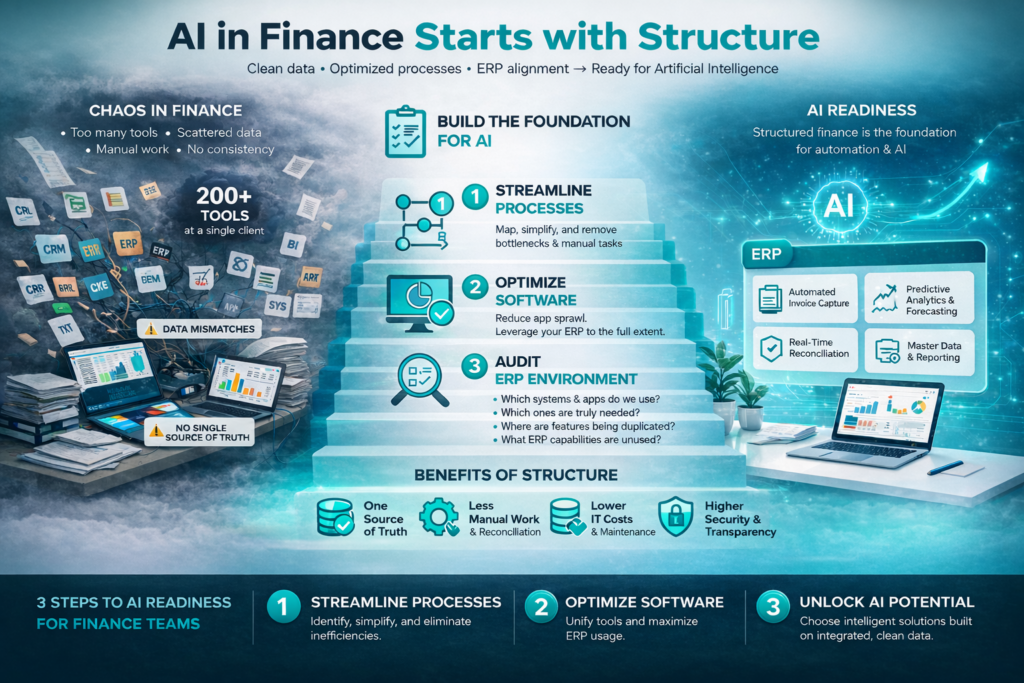
The phrase “AI in finance” is everywhere today. Automation, predictions, robotization, generative data analytics – it all sounds exciting. But the reality we observe in advisory and implementation projects shows one thing: before finance teams can effectively benefit from AI-based solutions, they need to get their foundations in order.
You simply cannot build an intelligent system on a disorganized foundation – and in many organizations, that foundation today is chaos in processes and… in software.
Process organization – the foundation of every implementation
The topic of organizing financial processes may seem obvious, yet it is still surprisingly often overlooked. Every company, regardless of size, has its own unique accounting, reporting, and controlling workflows which, over time, accumulate “workarounds,” Excel spreadsheets, additional steps, and supporting files.
So before we start talking about AI, it is worth asking a few simple questions:
- Are our processes up to date with the changing regulatory environment?
- Are they efficient and understandable for the entire team?
- Where do bottlenecks, manual activities, and repetitive tasks occur?
Only after mapping these areas do we gain a real foundation for automation — not only through AI, but also through existing ERP functionalities that are often simply… unused.
Step two: software rationalization, or “cleaning up the backyard”
However, this is only the beginning. In many finance departments we encounter a phenomenon that could be called “software inflation.” Over the years, in response to new requirements, legal changes, or urgent reporting needs, organizations have accumulated additional tools, applications, and temporary solutions. They were often meant to be short-term – but, as is often the case, “temporary” stayed for years.
One of our record-holding clients had more than 200 different tools and applications supporting broadly defined finance operations. The result? More chaos than support:
- constant reconciliations between systems,
- data discrepancies,
- lack of a single source of truth,
- enormous amounts of manual work and team frustration.
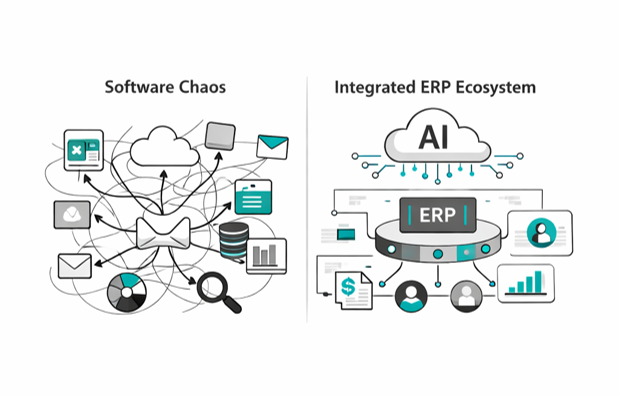
This phenomenon is not an exception. Rapidly changing regulations (e.g., KSeF, ESG, MDR, JPK), time pressure, and the need for quick responses mean that ERP vendors do not always keep pace with updates, and companies resort to “patchwork” solutions. As a result, several versions of the truth about the same data can coexist within a single finance department.
Before you buy a new AI tool – look at what you already have
When facing problems, the natural reaction is to reach for new technologies. “Maybe AI will solve it?” Maybe – but not immediately.
Before purchasing another application, it is worth pausing and asking: do we really know and fully utilize the capabilities of our current ERP system?
Many vendors – SAP, Microsoft, Oracle, IFS, Comarch, or Unit4 – have been developing their systems for years, implementing automation and AI components that support financial processes: from automatic invoice recognition, through cash flow forecasting, to intelligent account reconciliation.
Often, these features are already available but have simply not been activated or embedded into daily processes.
So before investing in another tool, it is worth conducting a small audit:
- What systems and applications support our finance function?
- Which of them are actually necessary?
- Where are functionalities duplicated?
- Does our ERP include modules that could replace some of these tools?
Benefits of reducing “software chaos”
Organizing the system landscape is not just about IT order or aesthetics. It brings real business benefits:
- a single source of truth – consistent data and reliable reporting,
- less manual work – fewer reconciliations and system imports,
- lower IT maintenance costs,
- improved data security,
- greater process transparency and accountability.
Moreover, only on such an organized foundation can AI demonstrate its true potential — because the data that machines “understand” must first and foremost be clean, consistent, and structured.
AI as the next step – but not the first
Only after completing two key stages – organizing processes and rationalizing software – does it make sense to return to the AI discussion..
The areas identified within processes that are repetitive, tedious, time-consuming, are ideal candidates for support from AI-based tools.
And one key recommendation: start with solutions compatible with your ERP.
Vendors often cooperate with partners who develop add-ons or AI micro-applications fully integrated into the ERP ecosystem. This helps avoid the risk of creating additional “technology islands” and maintains architectural transparency.
Implement technology thoughtfully
Technology should support finance teams – not frustrate them with an excess of tools. That is why, before starting another implementation, it is worth taking a step back, analyzing what you already have, and planning development consciously. After all, AI will not replace order – but order is a prerequisite for effective AI.
Summary: three steps to smart finance automation
- Organize processes – understand what you do, why you do it, and where time is being lost.
- Rationalize software – reduce the number of applications and leverage the full potential of your ERP.
- Implement AI consciously – only when the foundations are stable.
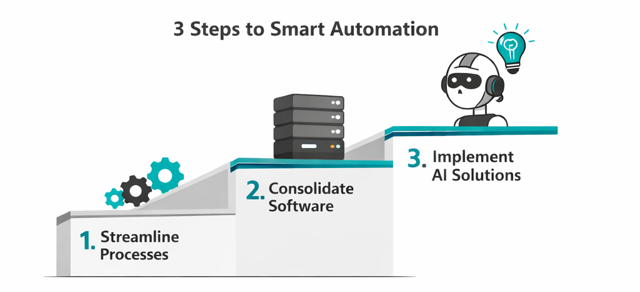
This sequence of actions is what allows finance to become a true business partner – modern, automated, but also consistent and reliable.
Udostępnij artykuł:


